

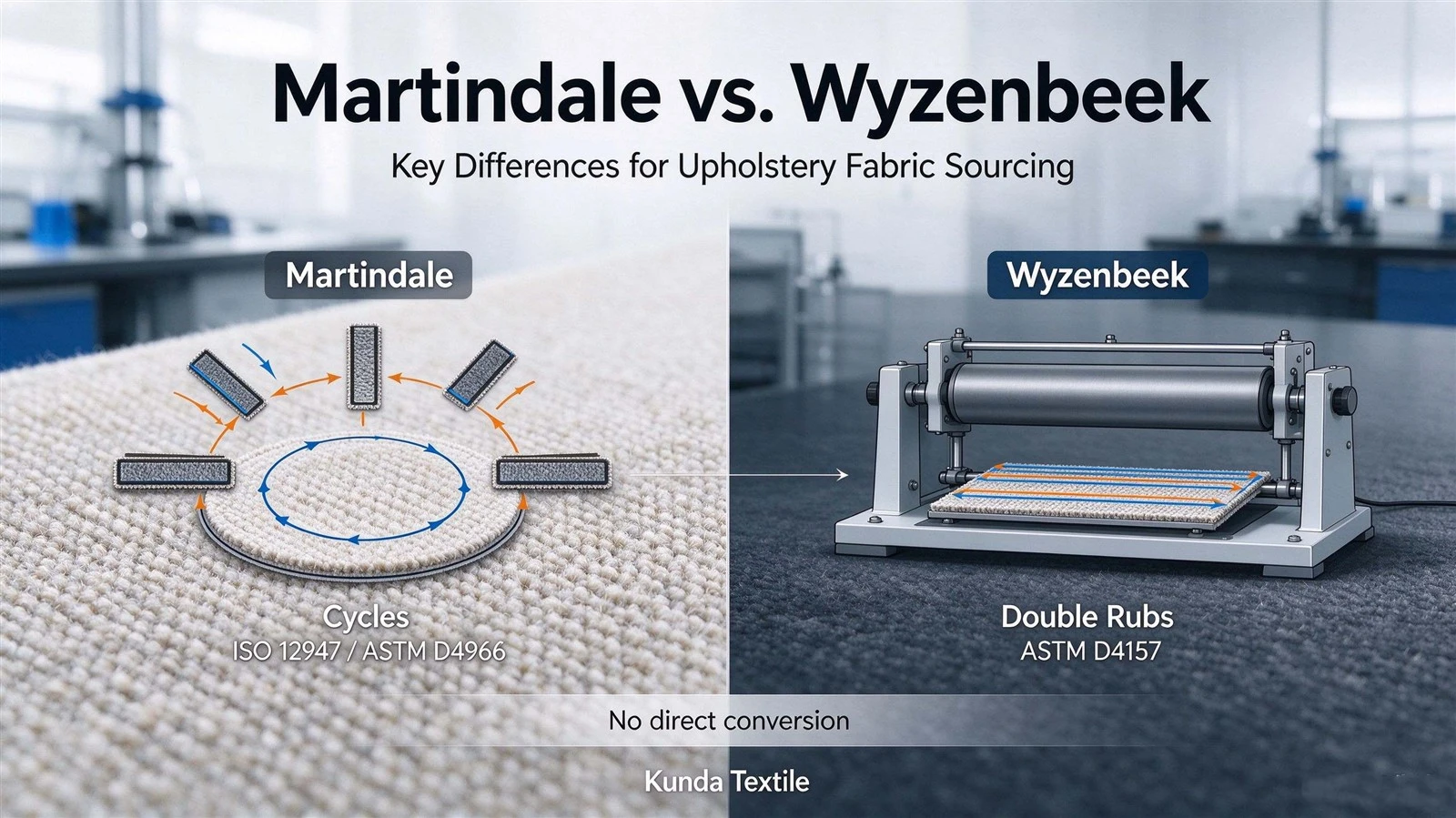
When sourcing upholstery fabric for sofas, chairs, hotels or commercial furniture projects, buyers often encounter two abrasion ratings: Martindale and Wyzenbeek.
Both methods evaluate a fabric's resistance to surface wear caused by rubbing, but they use different testing procedures and report results in different units. Their numbers are not directly interchangeable.
Understanding the difference helps furniture manufacturers, fabric wholesalers and project buyers compare technical specifications more accurately and avoid choosing materials based on misleading abrasion figures.
1. What Is an Upholstery Fabric Abrasion Test?
An abrasion test measures how a fabric surface responds to repeated rubbing under specified laboratory conditions.
For upholstery applications, abrasion resistance is one factor used to evaluate a fabric's suitability for seating and other furniture surfaces that experience regular contact.
However, abrasion resistance does not represent the complete durability of a fabric. Seam strength, pilling, colorfastness, fabric construction, cleaning methods and actual usage conditions can also affect product performance.
Before comparing test results, buyers should first identify the intended application, such as residential sofas, hotel seating, office furniture or other commercial upholstery projects.
2. What Is the Martindale Abrasion Test?
The Martindale test evaluates textile abrasion resistance using a Martindale abrasion tester.
During the test, a fabric specimen is rubbed against an abradant following a defined movement pattern. The result is generally expressed in cycles, according to the specified test procedure and evaluation endpoint.
Martindale testing is commonly referenced in textile specifications, particularly in markets where ISO or ASTM test methods are specified.
When reviewing a Martindale report, buyers should check:
- The test standard, such as ISO 12947 or ASTM D4966
- The reported number of cycles
- The applied pressure and test conditions
- The evaluation endpoint
- The tested fabric construction and finish
Important: ASTM D4966 itself states that the method is not considered satisfactory for acceptance testing of commercial fabric shipments because of poor between-laboratory precision. Buyers should therefore agree on the applicable test procedure, laboratory, sampling and acceptance criteria rather than relying on a single reported number.
3. What Is the Wyzenbeek Abrasion Test?
The Wyzenbeek method evaluates fabric abrasion resistance using an oscillatory cylinder tester.
In the test, a fabric specimen is subjected to repeated back-and-forth rubbing against a specified abradant. Results are commonly reported as double rubs.
The method is associated with ASTM D4157 and is frequently referenced in North American contract upholstery specifications.
When reviewing a Wyzenbeek report, buyers should confirm:
- Whether ASTM D4157 is specified
- The type of abradant used
- The reported number of double rubs
- The test endpoint and conditions
- Whether the tested sample matches the proposed production fabric
ASTM D4157 covers woven textile fabrics using the oscillatory cylinder tester. Buyers should confirm that the selected method is appropriate for the specific fabric construction.
4. Martindale vs. Wyzenbeek: Key Differences
The main differences are the testing equipment, rubbing movement, test procedure and reporting units.
| Comparison | Martindale | Wyzenbeek |
|---|---|---|
| Testing equipment | Martindale abrasion tester | Oscillatory cylinder tester |
| Movement | Defined multidirectional rubbing pattern | Back-and-forth rubbing |
| Common result unit | Cycles | Double rubs |
| ASTM reference | ASTM D4966 | ASTM D4157 |
| Other common reference | ISO 12947 | ASTM D4157 |
| Common specification markets | International textile specifications | North American contract upholstery specifications |
The two methods measure abrasion resistance differently. There is no reliable universal formula for converting Martindale cycles into Wyzenbeek double rubs.
For example, 40,000 Martindale cycles should not be described as equivalent to 30,000 Wyzenbeek double rubs.
If a project specification requires one particular test method, buyers should request results from that method instead of comparing figures from different procedures.
5. What Are the ACT Abrasion Guidelines for Upholstery?
The Association for Contract Textiles (ACT) publishes voluntary performance guidelines for contract fabrics.
For indoor woven and knit upholstery fabrics, ACT lists the following abrasion guidelines:
| Application | Wyzenbeek (ASTM D4157) | Martindale (ASTM D4966) |
|---|---|---|
| Low Traffic / Private Spaces | 15,000 double rubs | 20,000 cycles |
| High Traffic / Public Spaces | 30,000 double rubs | 40,000 cycles |
The Martindale guideline uses a pressure of 12 kPa. The Wyzenbeek guideline specifies ACT-approved #10 cotton duck as the abradant.
These figures are separate benchmarks for their respective test methods. They are not a conversion formula and should not be treated as mandatory requirements for every market, product or project.
For hotel furniture, office seating and other commercial projects, buyers should check the project specification and relevant market requirements before selecting a target abrasion level.
6. Does a Higher Abrasion Rating Mean Better Fabric Quality?
Not necessarily.
A higher abrasion result means that the test specimen withstood more rubbing under the specified test conditions. It does not automatically mean that the fabric will last longer in every application.
ACT explains that abrasion results do not reliably predict fabric lifespan. Actual performance and appearance retention can be affected by:
- Fiber composition
- Fabric construction and surface structure
- Backing and finishing processes
- Furniture design and upholstery workmanship
- Cleaning and maintenance
- Frequency and type of use
For example, a velvet upholstery fabric and a flat woven upholstery fabric have different surface structures. Their abrasion results should be considered alongside the intended use and other relevant performance requirements.
A high abrasion number alone is not enough to determine whether a fabric is suitable for a particular furniture project.
7. What Other Fabric Tests Should Furniture Buyers Consider?
Abrasion resistance is only one part of upholstery fabric evaluation. Depending on the project, buyers may also need to consider:
| Test or Property | What It Evaluates |
|---|---|
| Pilling resistance | Surface formation of pills or fuzz |
| Colorfastness to rubbing | Color transfer through rubbing |
| Colorfastness to light | Resistance to color change under light exposure |
| Seam slippage | Movement of yarns at a seam under stress |
| Tensile strength | Resistance to breaking under tension |
| Tear strength | Resistance to tearing |
| Cleaning resistance | Response to specified cleaning procedures |
Not every project requires every test. The required tests depend on the intended application, destination market, project specification and applicable standards.
8. What Should Buyers Ask Before Ordering Upholstery Fabric?
Before placing a bulk order, buyers should make sure that the supplier understands the technical requirements.
Use this checklist when requesting a quotation:
1. Confirm the application
Explain whether the fabric is intended for residential sofas, hotel seating, office furniture or another use.
2. Specify the abrasion test method
State whether the project requires Martindale or Wyzenbeek. Include the applicable standard and target result.
3. Request relevant test documentation
Ask whether a test report is available for the exact fabric construction and finish being quoted. Check the sample description, test method, conditions and report date.
4. Confirm the fabric construction
Discuss composition, weight, width, backing, pile structure and any special finishing process.
5. Approve a physical sample
Review the color, hand feel, surface appearance and construction before bulk production.
6. Agree on quality requirements
Confirm the sampling procedure, inspection method and acceptance criteria in writing before production.
A clear specification helps both parties reduce misunderstandings and provides a more consistent reference for bulk production.
9. Source Upholstery Fabrics for Your Furniture Collection
The right upholstery fabric depends on more than an abrasion rating. Buyers should consider fabric construction, surface appearance, application, maintenance requirements and the technical specifications of the project.
Kunda Textile offers upholstery and home furnishing fabric options, including velvet, Holland velvet, plush, chenille, bouclé and other decorative fabrics.
Explore our Velvet Fabric Collection, Chenille Fabric Collection and Home Deco Fabric Collection.
If your project has specific abrasion requirements, share the required test method, target result, intended application and fabric reference when contacting our team.
This allows us to discuss the appropriate product options and whether relevant test documentation is available.
Contact Kunda Textile to discuss your upholstery fabric sourcing requirements.
Frequently Asked Questions
1. What is the difference between Martindale and Wyzenbeek?
Martindale uses a defined multidirectional rubbing movement and reports cycles. Wyzenbeek uses an oscillatory back-and-forth rubbing method and reports double rubs. Their results cannot be directly converted.
2. Is 30,000 Wyzenbeek equal to 40,000 Martindale?
No. These are separate ACT high-traffic guideline values for different test methods, not equivalent measurements.
3. What is a good abrasion rating for upholstery fabric?
There is no single rating suitable for every fabric and application. Buyers should follow the relevant project specification and applicable performance guidelines.
4. Does a higher Martindale or Wyzenbeek result mean longer fabric life?
No. Abrasion results measure performance under specified laboratory conditions and do not guarantee actual service life.
5. Should I request an abrasion test report before ordering?
If abrasion resistance is a project requirement, ask for a relevant report and verify the test method, sample identification and testing conditions. Agree on the acceptance procedure with the supplier before placing a bulk order.


